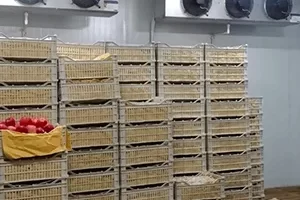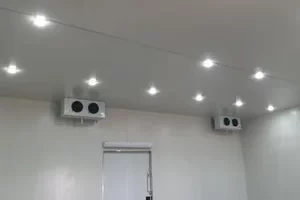



What Is a Pharmaceutical Cold Room and Why Do We Need It?
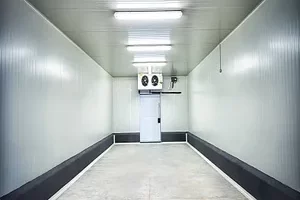
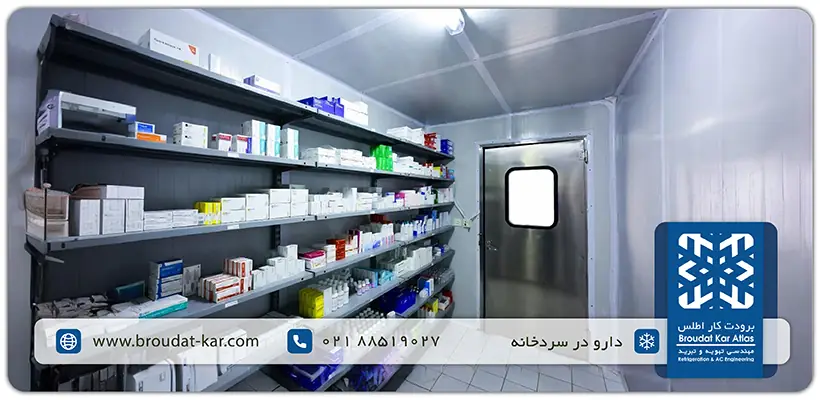
A pharmaceutical cold room is a precisely temperature-controlled space designed for the safe storage of medicines, vaccines, and biological products. The main purpose of these systems is to preserve the active ingredients of drugs and prevent them from spoiling. In fact, the absence of a standard cold room can put the entire pharmaceutical supply chain at risk by compromising product quality and effectiveness.
According to a report by Ubisense, more than 50% of vaccines worldwide are lost due to improper storage conditions — a statistic that clearly highlights the importance of maintaining correct temperature and humidity levels. Research by Maersk also shows that around 35% of medicines worldwide require a cold chain to remain effective.
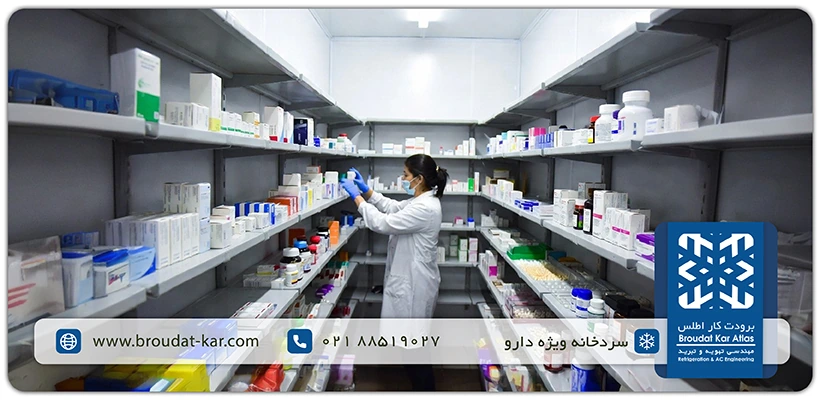
What Are the Benefits of Using a Pharmaceutical Cold Room?
Using a pharmaceutical cold room plays a vital role in maintaining the integrity of the pharmaceutical cold chain. Key benefits include:
- Preserving the chemical and structural properties of medicines and preventing loss of efficacy
- Preventing changes in color, odor, or therapeutic effect caused by temperature fluctuations
- Maintaining the stability of biological products such as vaccines and serums
- Controlling the growth of microorganisms and reducing the risk of cross-contamination
- Extending the shelf life of medicines and reducing waste caused by spoilage
- Ensuring consistent quality and stability of medicines throughout the entire cold chain process
Types of Pharmaceutical Cold Rooms (by Temperature and Application)
In the pharmaceutical industry, no product can be stored without carefully considering its temperature requirements. Biological and chemical compounds can lose their structure – and therefore their effectiveness – when exposed to excessive heat or cold.
For this reason, designing and installing the right type of pharmaceutical cold room for each product is a critical part of the drug production and distribution process. These cold rooms are generally classified by temperature range, product type, and application, as outlined below.
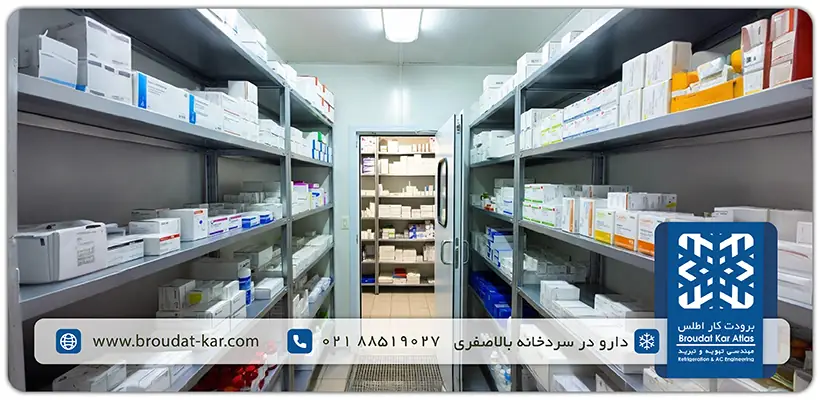
Refrigerated Pharmaceutical Cold Room (2–8 °C)
This is the most common type of pharmaceutical cold room. It is used for storing vaccines, insulin, serums, biological products, and many general medicines.
The 2–8 °C temperature range helps maintain the stability of active pharmaceutical ingredients and prevents the growth of microorganisms.
Refrigerated pharmaceutical cold rooms are typically equipped with:
- Data loggers for continuous temperature recording
- Precision air circulation and ventilation systems
- Temperature sensors and alarm systems to prevent fluctuations
Low-Temperature Pharmaceutical Cold Room (−18 to −40 °C or lower)
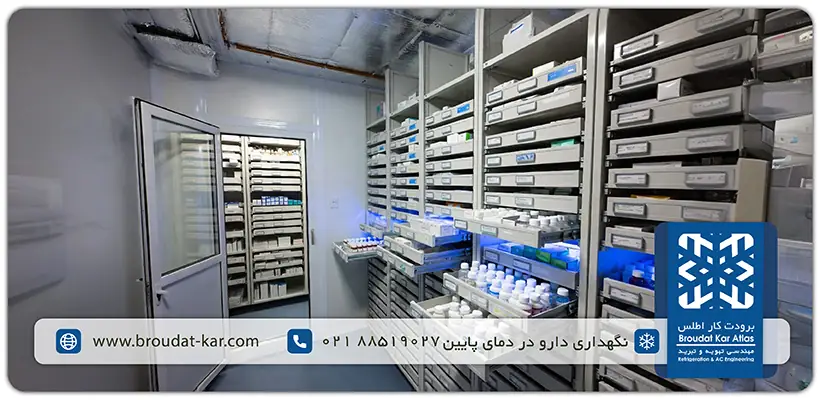
Low-temperature pharmaceutical cold rooms are used for special products such as plasma, highly sensitive vaccines, pharmaceutical raw materials, and blood derivatives.
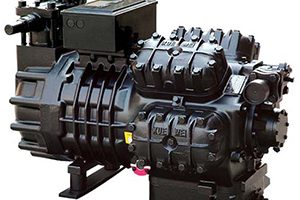
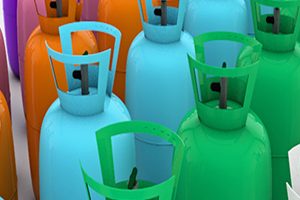
These systems use industrial screw or reciprocating compressors and refrigerants such as R404A or R134a to maintain the internal temperature within the required standard range.
Pharmaceutical Clean Room (Clean Room)
A pharmaceutical clean room is a controlled environment with a very low concentration of airborne particles. It is used in the production, packaging, and quality control of sterile medicines.
Key features typically include:
- Positive room pressure
- HEPA-filtered ventilation systems
- Antibacterial, easy-to-clean floors and wall surfaces
These conditions help minimize contamination risks during critical pharmaceutical processes.
Mobile Pharmaceutical Cold Room
For the transport of vaccines, temperature-sensitive medicines, and laboratory samples, mobile pharmaceutical cold rooms are used.
These systems are usually built as containers equipped with:
- Integrated refrigeration units
- Accurate temperature monitoring and control systems
They ensure that the pharmaceutical cold chain is maintained throughout the entire transportation route. Mobile cold rooms are one of the most effective solutions for pharmaceutical exports and long-distance distribution.
What Are the Applications of Pharmaceutical Cold Rooms?
The use of pharmaceutical cold rooms is not limited to manufacturing plants; they are also critical in distribution centers, healthcare facilities, and many other parts of the supply chain.
The main applications of pharmaceutical cold rooms include:
- Pharmaceutical and biotechnology plants:
For storing raw materials, intermediates, semi-finished products, and vaccines at various stages of production. - Central warehouses and pharmaceutical logistics hubs:
To maintain standard temperature conditions while storing and preparing consignments for shipment to pharmacies and healthcare centers. - Hospitals and medical centers:
Using hospital pharmaceutical stores and cold rooms to keep serums, vaccines, and temperature-sensitive injectable drugs under controlled conditions. - Chain and retail pharmacies:
For storing temperature-sensitive medicines such as insulin and liquid antibiotics. - Vaccine and serum distribution centers:
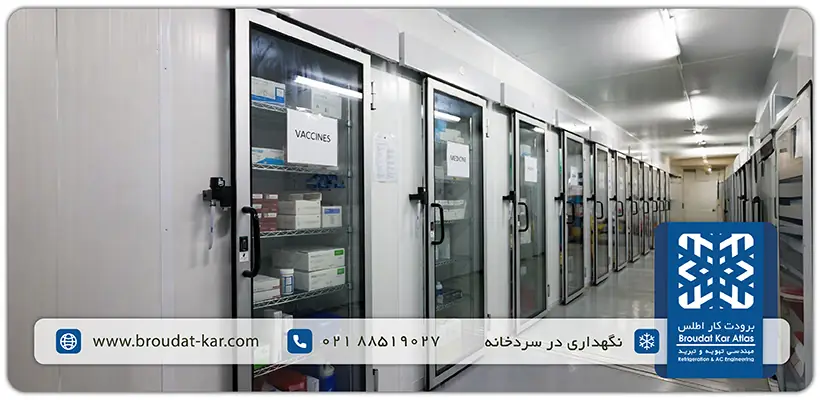
Especially in national vaccination programs, where dedicated vaccine cold rooms with 24/7 monitoring systems are required to ensure cold chain integrity at all times.
What Features Should a Standard Pharmaceutical Cold Room Have?
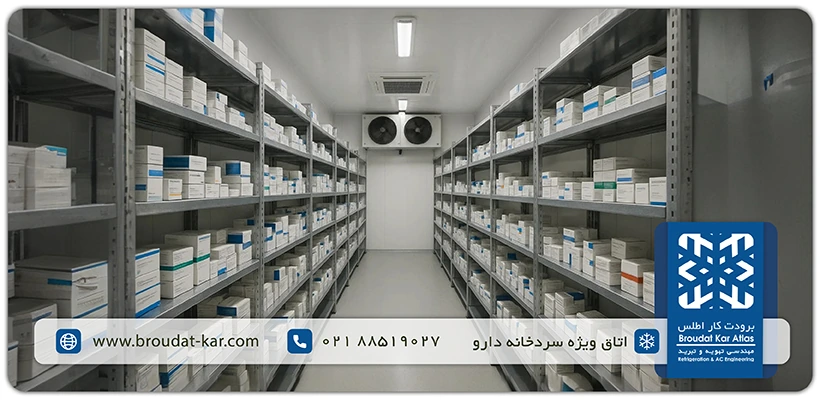
Maintaining the quality of medicines is not just about keeping them “cold”. A whole set of technical, hygienic, and structural requirements must be met. A standard pharmaceutical cold room is designed in line with WHO, GMP, and national Ministry of Health guidelines to ensure that temperature, humidity, and ventilation are uniform and reliable throughout the entire storage area.
Precise Temperature and Humidity Control (Temperature Stability)
In a compliant pharmaceutical warehouse, temperature should be controlled with a maximum tolerance of ±0.5 °C, and relative humidity should be maintained within 45–60%.(Source)
This stability prevents the degradation of active ingredients and inhibits the growth of microorganisms. Automated control systems and regular calibration of sensors are essential to ensure accurate performance.
Proper Ventilation and Uniform Airflow
Ventilation in a pharmaceutical cold room must be designed to provide uniform air circulation in all areas of the space.
This prevents the formation of hot or cold spots and keeps the storage temperature within the required standard range for all products, not just those near the cooling units.
Robust Structure with Concrete Floor and Durable Flooring
A solid structure with a concrete floor and non-slip, washable, chemical-resistant flooring is a key hygiene and safety requirement for pharmaceutical cold storage.
Such construction makes cleaning easier, prevents moisture ingress, and helps inhibit mold and fungal growth.
Safe Distance from Polluting Industries (Smoke and Dust)
The location of a pharmaceutical cold room should be chosen away from sources of industrial pollution such as smoke, dust, or chemical vapors.
This distance from environmental contaminants reduces the risk of harmful particles entering the warehouse and helps maintain hygienic storage conditions.
Standard Racking and Pallet Systems
According to pharmaceutical storage standards, medicines must not be placed directly on the floor.
Using metal shelving or durable pallets helps maintain proper airflow around the products and prevents moisture transfer to pharmaceutical packaging, thereby protecting both packaging integrity and product quality.
Door and Openings Protected with Strip Curtains or Air Curtains (Pest Control)
Doors, openings, and windows should be protected with PVC strip curtains, silicone curtains, or air curtains to prevent the entry of insects, birds, and other pests.
This simple but critical measure plays a major role in keeping the environment clean and ensuring product safety.
Continuous Monitoring with Data Loggers and Multiple Sensors
Temperature and humidity in a pharmaceutical cold room must be monitored continuously and automatically.
Data loggers and smart sensors are installed at several points throughout the cold room, and in the event of any deviation, they trigger audible alarms or send SMS/remote notifications so operators can react before product quality is compromised.
Backup Refrigeration Circuit (Redundancy in Case of Failure)
A standard pharmaceutical cold room must be equipped with a backup refrigeration circuit or redundant system.
If the main compressor or primary system fails, the backup system automatically takes over to prevent a sudden rise in temperature and avoid costly product losses. This redundancy is essential for maintaining the integrity of the pharmaceutical cold chain.
What Are the Storage Conditions for Medicines in a Pharmaceutical Cold Room?
The table below summarizes the recommended storage conditions for some important groups of medicinal products:
| Description | Storage Temperature (°C) | Type of Medicine |
| The most temperature-sensitive group of medicines, requiring continuous temperature monitoring. | 2–8 | Vaccines and insulin |
| Must be stored at freezing temperatures to prevent protein degradation. | Down to −40 | Plasma and blood products |
| Stability decreases when stored above this temperature range. | 5–10 | Antibiotics and eye drops |
| Require a dry, well-ventilated environment. | 15–25 | Supplements and herbal medicines |
List of Equipment in a Pharmaceutical Cold Room
In the design and construction of a standard pharmaceutical cold room, selecting high-quality, precise equipment is absolutely critical. Each component plays a key role in controlling temperature, humidity, and the stability of the cold chain.
The main equipment used in pharmaceutical cold rooms includes:
- Pharmaceutical cold room compressor: Piston or screw type, using refrigerants such as R404A or R134a to ensure stable and precise cooling.
- Hygienic, corrosion-resistant condenser and evaporator: Designed for efficient heat exchange and contamination prevention, typically made of stainless steel with anti-corrosion coating.
- Pharmaceutical unit cooler: Ensures uniform distribution of cold air throughout the room, with specially designed fins and low-noise fans to maintain consistent temperature conditions.
- Sensors and data loggers (PLC control system): For continuous recording of temperature and humidity, and automatic alarms in case of any deviation from the standard range.
- Smart electrical control panel and remote monitoring: For precise management, adjustment, and supervision of system operation via digital and online control systems.
- Emergency power generator: Supplies power to critical equipment during power outages and prevents sudden temperature rise and product loss.
- Ventilation and air filtration system (HEPA filter): Purifies the air and prevents the entry of airborne particles and contaminants into the pharmaceutical storage area.
- Low-temperature and power-failure alarm system: Provides immediate notification to operators in case of cooling system malfunction or power cut, helping to avoid costly pharmaceutical losses.
What Standards Must Be Followed When Building a Pharmaceutical Cold Room?
Complying with pharmaceutical cold room standards ensures that medicines remain completely safe and maintain their quality throughout the cold chain. These standards consist of a set of international guidelines and national regulations that define how to design the facility, control temperature, ventilation and humidity, and select hygienic construction materials.
International Standards for Pharmaceutical Cold Rooms
At the global level, organizations such as WHO, GMP, GDP, GSP, and the FDA have issued detailed guidelines for the construction and operation of pharmaceutical cold rooms.
These guidelines cover:
- Precise temperature control
- Maintaining appropriate relative humidity
- Proper air conditioning and ventilation
- Prevention of cross-contamination
The use of corrosion-resistant and anti-fungal materials, the design of positive pressure systems, and the installation of data loggers for continuous data recording are also among the fundamental requirements.
Adhering to these rules ensures that the pharmaceutical cold chain is preserved during all stages of storage and transportation, minimizing the risk of product degradation.
National Standards and Requirements in Iran
In Iran, the construction of a standard pharmaceutical cold room must comply with the guidelines of the Ministry of Health and the Food and Drug Organization.
These authorities not only supervise the design and construction process, but also place special emphasis on:
- The use of hygienic, easy-to-clean materials
- Adequate ventilation and air quality
- Effective contamination control
Obtaining an operating license for a cold room depends on providing valid calibration reports, having a reliable data recording system, and implementing automatic temperature and humidity control.
Together, these national requirements and international standards form a comprehensive framework for safeguarding medicine quality and ensuring the accurate and reliable performance of pharmaceutical cold storage facilities.
Step-by-step stages of building a pharmaceutical cold room
In the process of building a pharmaceutical cold room, every step must be carried out in accordance with international standards and the requirements of the Ministry of Health and the Food and Drug Organization, so that the pharmaceutical cold chain is maintained without error. If you care about quality and compliance with global standards, it is worth knowing that the company Atlas refrigeration, relying on its engineering experience and numerous pharmaceutical projects, follows this path with great precision and in line with the latest international standards.
Assessing medicine volume and determining cold room capacity
The first step in designing a pharmaceutical cold room is an accurate assessment of the volume of medicines, the type of packaging and the required storage duration. This stage determines what capacity is needed for the project and which type of refrigeration system will provide the highest efficiency.
Calculating refrigeration load and selecting the refrigerant
In this stage, engineers calculate the required refrigeration load by taking into account environmental conditions, heat losses and the type of products. Then a suitable refrigerant is selected, for example R404A for below-zero cold rooms or R134a for above-zero cold rooms, so that a balance is achieved between efficiency, temperature stability and energy consumption.
Designing foundation, insulation and ventilation drawings
In the third stage, technical drawings are prepared, including the structure, walls, ventilation system and piping routes. Precise insulation using polyurethane panels with a thickness of 10 to 15 centimeters helps prevent energy loss and fluctuations in internal temperature. The ventilation system must also be designed in such a way that uniform airflow is maintained throughout the entire space.
Manufacturing, installation and commissioning of units
At this stage, the process of building the pharmaceutical cold room enters the execution phase. The main equipment, including the compressor, condenser, evaporator and smart electrical control panel, is installed and the refrigeration system is tested. The accuracy of installation and insulation of connections is especially important here, because even the smallest leakage can disrupt the performance of the system.
Testing temperature and humidity performance under real conditions
Before final handover, the cold room is subjected to precise tests of temperature, humidity and, where required, positive pressure. Data logger sensors are installed at different points to ensure that the temperature difference at no point exceeds the standard limit of ±0.5 °C.
Final handover with technical documentation and operating training
At the end of the project, all drawings, calibration reports, test results and operating manuals are delivered to the client. The company Atlas refrigeration not only delivers the cold room, but also provides full training for operators to ensure proper medicine storage and stable long-term performance of the system.
Services of Atlas refrigeration Co. for pharmaceutical cold rooms
Atlas refrigeration has gained over 30 years of experience in the design and implementation of refrigeration systems and is therefore considered one of the pioneers in the construction of pharmaceutical cold rooms in Iran.
The main services of Atlas refrigeration Co. in the field of pharmaceutical cold rooms include:
- Tailor-made design based on the type of medicine and project capacity
- Construction of above-zero and below-zero pharmaceutical cold rooms with smart control systems
- Installation, commissioning and full performance testing of temperature and humidity in pharmaceutical cold rooms
- One-year cold room warranty and 15 years of after-sales service
- Training of the operation team for correct use and maintenance of the system
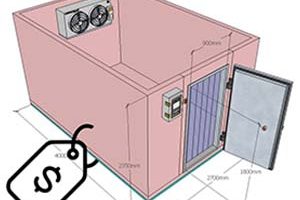
How much does it cost to build a pharmaceutical cold room?
The cost of a pharmaceutical cold room depends on a variety of factors and cannot be defined as a fixed amount. Required capacity and temperature, type of refrigerant, equipment brand, level of automation, panel material and the thickness/quality of insulation are all key elements that determine the overall cost of building a pharmaceutical cold room. The use of smart systems for data logging, SMS alarms and remote control can also influence the final price.
For an accurate estimate, the project details must be reviewed by technical experts so that the cost of the pharmaceutical cold room can be calculated and quoted specifically for your project.
Purchasing a pharmaceutical cold room and order conditions
The process of purchasing a pharmaceutical cold room from Atlas refrigeration is fully engineered and carried out step by step, so that the technical and hygienic requirements of each project are covered with precision. The ordering stages usually include initial technical consultation, customized design, submission of a proforma invoice, manufacturing, installation and final handover.
Customers can submit their requests or ask for a price quotation for a pharmaceutical cold room either through the online order form on the website or by direct contact with the technical experts. Depending on the capacity and type of project, the delivery time varies between 15 and 120 days.
This transparent approach has led to Atlas refrigeration Co. being recognized as one of the reputable brands in the field of pharmaceutical cold room orders.
Final remarks
The pharmaceutical industry is inconceivable without standard pharmaceutical cold rooms. Maintaining the pharmaceutical cold chain not only guarantees the effectiveness of medicines, but also has a direct impact on patient health. Atlas refrigeration, with extensive experience in the design, calculation, construction and execution of pharmaceutical projects, is ready to provide free specialist consulting to manufacturers, hospitals and pharmaceutical distribution centers.
To receive a tailored proforma invoice or technical consultation, you can contact the experts at Atlas refrigeration and benefit from the latest solutions for the design of pharmaceutical cold storage facilities.