


How to cut industrial cold room energy costs by 50% with the right door selection (a detailed scientific analysis)
In this article, we scientifically examine how choosing the right type of industrial cold room door, insulation, control system and even staff usage patterns can reduce cold room energy consumption by up to 50%. To do this, we analyze everything from the phenomenon of air infiltration to modern technologies such as high-speed doors (High-Speed Doors) and air curtain systems (Air Curtain), using real data and case studies.

In the final part, we introduce the localized solutions developed by Atlas refrigeration; a team which, with more than three decades of experience in the design and manufacture of industrial cold room doors – hinged, sliding, automatic and controlled-atmosphere – in line with international standards, has helped pave the way for energy optimization in Iranian industries.
Energy loss during opening and closing of industrial cold room doors
One of the most important sources of energy waste in cold rooms is a phenomenon known as infiltration load or air infiltration. Every time the cold room door is opened, the warm and humid outside air is replaced with the cold air inside. This seemingly simple exchange brings in heat and moisture and leads to frosting on the evaporator, which directly increases the refrigeration load of the system.
A study by the U.S. Department of Energy (DOE) and an ASHRAE report have shown that outside air entering through doors can account for more than 50% of the refrigeration load in high-traffic cold rooms. In other words, in some cold stores, half of the electrical power consumed by the refrigeration system is spent on cooling air that only enters the space while the door is open.
For this reason, the cold room door should not be viewed merely as a physical element, but as a critical point in overall energy efficiency.
Several factors influence the intensity of this energy loss, including:
- The temperature difference between inside and outside
- Humidity level
- Wind speed
- The length of time the door remains open
The greater the temperature difference between the inside and outside of an industrial cold room, the more the rate of heat and moisture transfer increases, in some cases almost exponentially.
In addition to physical factors, human behavior also plays a major role in increasing or reducing energy consumption. In cold rooms where staff leave doors open for too long or use slow, manually operated doors, the wasted energy can be several times higher than in a controlled situation. To prevent these losses, solutions such as installing automatic doors with motion sensors and smart timers can be used.
The study made to predict energy savings achieved by the application of all efficiency measures referred in Table 11 showed that it is possible to obtain gains of around 30–40 %. It also may be noted that installation of an air curtain device reduced dramatically final consumptions (at most 37 %), showing that this measure was extremely interesting to reduce energy bills, especially when many accesses are made to the chamber
Types of industrial cold room doors and their energy loss comparison
Below are the common types of cold room doors, each of which, depending on its operation and structure, has a different impact on overall energy efficiency:
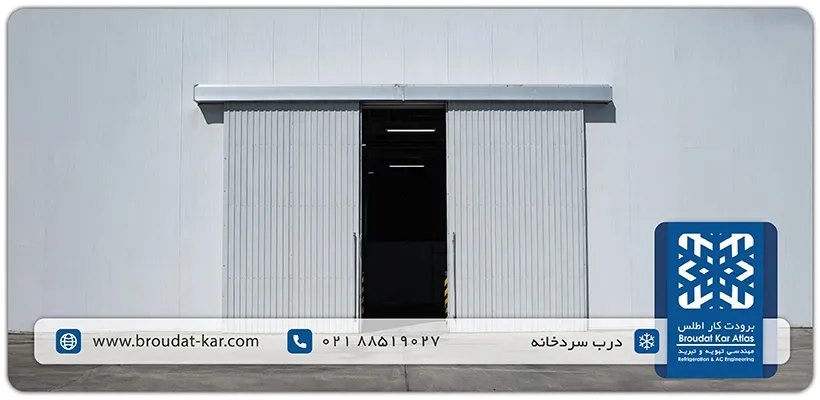
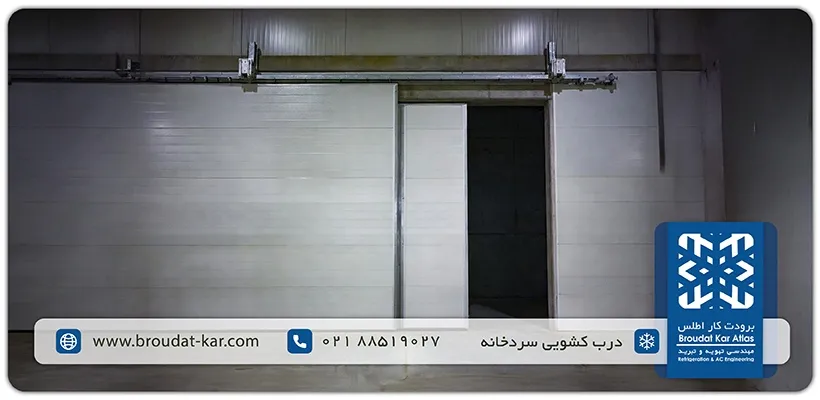
Sliding door
Suitable for high-traffic cold rooms; high operating speed, good sealing and low space requirement. Thanks to reduced door open time, these doors significantly decrease heat infiltration.
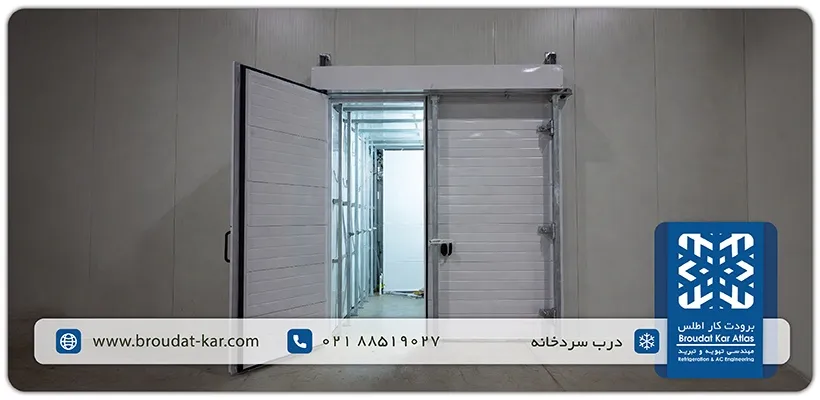
Hinged door
A more economical choice for small cold rooms or areas with limited traffic. Because opening and closing are slower compared to sliding models, energy loss is higher.
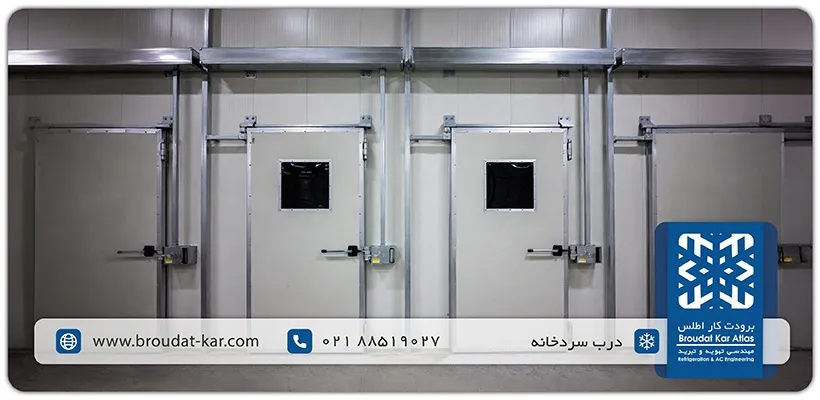
Automatic door
Operated by an electric motor and motion sensors, it opens when the operator approaches and closes automatically after passage. In large industrial environments, these systems can reduce energy consumption by up to 30%.
Controlled atmosphere door (CA Door)
Designed for highly sensitive environments such as fruit storage and pharmaceuticals. In addition to high thermal insulation, these doors help control internal pressure and gas composition, although their initial cost is relatively high.
Folding door
A mid-range option for limited spaces; fast opening and closing, easy installation and moderate energy performance.
| Suitable for | Key notes | Heat infiltration rate | Energy savings | Door type |
| High-traffic cold rooms | Fast opening and closing, minimal space required | Low | High | Sliding (rail) door |
| Small cold rooms | Requires large swing/clearance area | High | Lower | Hinged door |
| Large industrial cold rooms | Smart control, long service life | Low | High | Automatic (electric) door |
| Specialized cold rooms | High precision, high initial cost | Very low | Very high | Controlled atmosphere door |
| Limited spaces | Reasonable cost, average performance | Medium | Medium | Folding door |
Latest technologies for reducing energy loss in industrial cold rooms
In recent years, leading manufacturers of refrigeration equipment such as Rite-Hite, Rytec and GS Doors have focused on designing high-speed and intelligent doors, and have succeeded in significantly reducing energy consumption in cold rooms. These new technologies not only prevent the infiltration of warm, humid air, but also help maintain stable internal temperatures and extend the service life of refrigeration equipment.
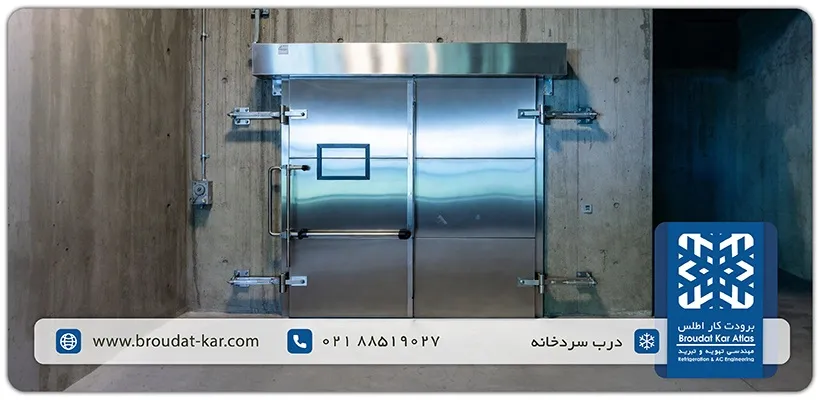
High-speed doors
These doors, with opening and closing speeds of up to 1.5 meters per second, minimize the contact time between indoor and outdoor air. A study conducted by the Technical University of Munich reported that using such doors in a food supply chain warehouse resulted in around a 30% reduction in energy costs over a single season.
Air curtain systems and double-door vestibules
Air curtain systems and double-door vestibules are among the most effective technologies for preventing warm, humid air from entering a cold room. An air curtain creates a high-pressure air layer above the doorway that acts like an “invisible wall” between the cold and warm areas, blocking direct temperature and moisture exchange.
By contrast, a double-door vestibule uses two successive doors (one on the outside and one on the inside), designed so that both doors are never open at the same time; as a result, heat transfer is reduced to a minimum.
Smart doors with motion sensors and automatic control of open time
One of the latest technologies on the market is smart doors equipped with presence detectors and ambient temperature sensors. These doors only open when an operator or forklift passes through, and close immediately afterwards.
In a field study by the RD&T Institute on the Coldmaster model (a type of industrial air curtain), it was shown that using an air curtain can prevent around 60–70% of cold air and energy loss while the cold room door is open.
These doors are also connected to energy management systems, so that data on door-open time and traffic frequency can be recorded and used for detailed energy efficiency analysis.
What is the return on investment for replacing an industrial cold room door?
Investing in the replacement or upgrade of an industrial cold room door is usually one of the smartest economic decisions for food, pharmaceutical and cold chain industries, because this change directly affects energy consumption, internal temperature stability and maintenance costs.
For example, in a case study, Hansen Storage in the state of Wisconsin was able to keep its freezer temperature about 6 °F (equivalent to 3.3 °C) lower after installing insulated, high-speed Rite-Hite doors. This improvement reduced energy consumption and led to a return on investment (ROI) of less than two years for the cost of the new doors(source).
According to the project manager:
“On the very first day after installation, the internal temperature was clearly more stable, and we no longer needed frequent door repairs.”
In similar experiences in Europe and North America, the ROI of installing high-speed, insulated doors is typically reported to be between 1 and 3 years, depending on factors such as electricity rates, cold room operating hours and traffic intensity.
Overall, the data shows that replacing old doors with insulated high-speed models not only delivers sustained energy savings, but also reduces annual operating costs by tens of thousands of dollars per cold room thanks to fewer breakdowns and less temperature loss.
The importance of control, monitoring and maintenance for preserving efficiency
Even the best cold room door will gradually lose its insulation and sealing properties if it is not properly maintained. Periodic inspection of the sealing gaskets, hinges and rails plays a key role in maintaining thermal performance. When gaskets dry out or tear, warm air infiltration begins and the compressor is forced to work harder to compensate.
One of the modern tools in this field is smart monitoring systems for door threshold temperature. These sensors are installed at the opening and report any abnormal temperature fluctuation or prolonged door-open time to the central control system. The data collected from these sensors can reveal traffic patterns and help cold room managers optimize energy consumption.
Alongside technology, human behavior is also a critical factor. Training staff on the importance of closing doors quickly and using lower-traffic routes for forklift movement can make a noticeable difference in energy use. An energy-saving culture is the essential complement to intelligent design.
Standards for the design, installation and maintenance of cold room doors
For stable and safe operation, it is essential to comply with international standards when designing and installing industrial cold room doors. Some of the most important requirements are:
- Use of aluminum or stainless steel frames with anti-corrosion coating for high durability
- Proper installation of sealing strips and peripheral insulation to prevent air infiltration
- Designing an appropriate floor slope in the door area to avoid water accumulation and icing
- Performing regular sealing and leakage tests in accordance with EN 13241 guidelines
- Compliance with safety control system standards according to DIN 18650 and quality management systems such as ISO 9001
Following these requirements not only increases the service life of the door, but also keeps the refrigeration performance stable and prevents efficiency losses in key equipment such as compressors.
Recommended solutions for the Iranian market
Iran’s climate ranges from very hot to very cold regions; therefore, the type of door must be selected in accordance with local climatic conditions:
- In hot and humid areas such as Bandar Abbas, Ahvaz and Kerman, it is recommended to use doors with high thermal insulation and powerful air curtains to prevent the ingress of ambient heat.
- In cold regions such as Ardabil, Hamedan and Tabriz, it is essential to use high-speed doors equipped with heating elements to prevent icing on the frame and seals.
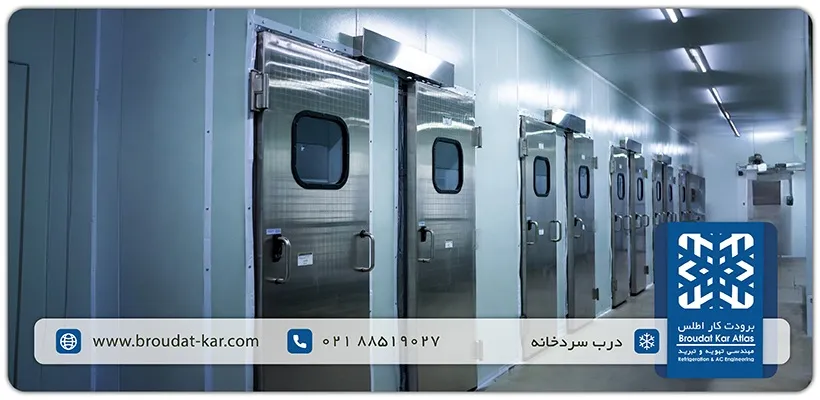
Domestic companies such as Atlas refrigeration, with more than three decades of experience in designing and manufacturing various types of cold room doors (hinged, sliding, automatic and controlled atmosphere), have made it possible to design and produce products tailored to the needs and climate of each region.
Summary
Overall, scientific evidence from sources such as ASHRAE shows that choosing the right industrial cold room door, together with complementary systems such as air curtains and automatic control, can reduce between 30 and 70 percent of the energy losses caused by air infiltration.
Investment in this area usually has a payback period of less than three years and, in addition to financial savings, increases the service life of refrigeration equipment and stabilizes product temperatures.
If you are currently using old doors or doors without proper sealing, it is time to carry out a technical assessment. Atlas refrigeration, with free consulting, customized design, specialist installation, a one-year warranty and 15 years of after-sales service, is ready to support you on the path to energy optimization and improved performance of your cold room.