

Ammonia Refrigeration Pump: Complete Guide to Operation, Selection and Troubleshooting
In small industrial and commercial cold-storage systems, particularly systems using fluorinated refrigerants, an expansion valve generally controls and feeds refrigerant directly into the evaporator. Large ammonia refrigeration systems, however, often use a liquid overfeed or recirculation arrangement because a direct-expansion configuration may not meet the cooling requirements of a large industrial installation.
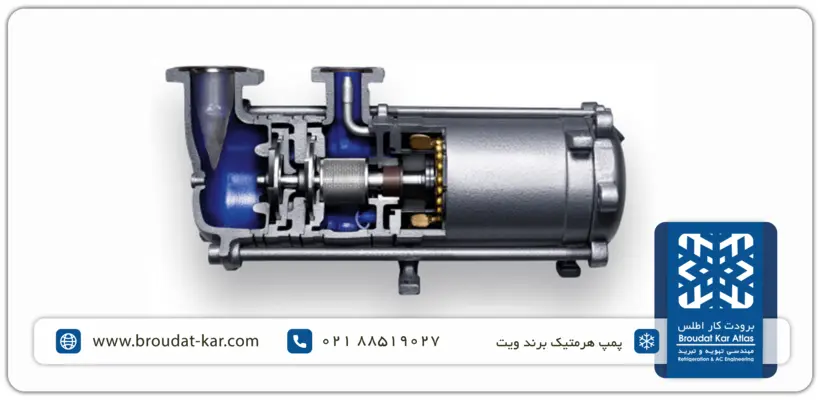
The ammonia refrigeration pump draws liquid refrigerant from the liquid separator and circulates it to the evaporators at a flow rate several times higher than the evaporation rate. This arrangement improves heat transfer and helps maintain uniform refrigerant coverage across the evaporator surfaces. Because a pump failure can interrupt refrigerant circulation across the system, understanding pump operation, selection, troubleshooting and cavitation prevention is essential for refrigeration designers and technical managers.
What Is the Role of an Ammonia Pump in a Refrigeration System?
To understand the role of an ammonia refrigerant pump, it is useful to compare two common refrigeration arrangements: Direct Expansion (DX) and Liquid Overfeed.
DX vs. Liquid Overfeed Ammonia Refrigeration
- Direct Expansion (DX): Liquid refrigerant leaving the condenser or liquid receiver passes through an expansion valve, experiences a pressure drop, and enters the evaporator directly. As the refrigerant travels through the evaporator tubing, it progressively evaporates and returns to the compressor as superheated vapor.
- Liquid Overfeed: In an industrial ammonia system, refrigerant first enters a low-pressure liquid separator. The ammonia pump draws cold liquid refrigerant from the separator and circulates it through the evaporators at an overfeed ratio commonly described in the source as 1:3 to 1:5. The evaporator outlet returns a liquid-vapor mixture to the separator; vapor travels to the compressor while unevaporated liquid returns to the pump circuit.
Technical and Economic Benefits of Liquid Overfeed Ammonia Refrigeration
- Maximum heat transfer: Extra liquid keeps the internal evaporator surfaces thoroughly wetted and increases the heat-transfer capability.
- Higher coefficient of performance (COP): The source indicates that the fully wetted evaporator can allow a higher evaporation temperature and may reduce compressor power, with a reported 10–15% increase in overall COP.
- Uniform temperature distribution: Large storage rooms and rapid-freezing tunnels can maintain more consistent evaporator surface temperatures and reduce temperature fluctuation caused by refrigerant distribution.
- Compressor protection: Because the compressor suction line is connected above the liquid separator, the arrangement reduces the risk of liquid slugging reaching the compressor.
Types of Ammonia Refrigeration Pumps: Structural and Application Comparison
Pump selection affects project suitability, machinery-room safety and maintenance requirements. The source divides ammonia pumps into two main categories: canned motor pumps and mechanical-seal pumps.
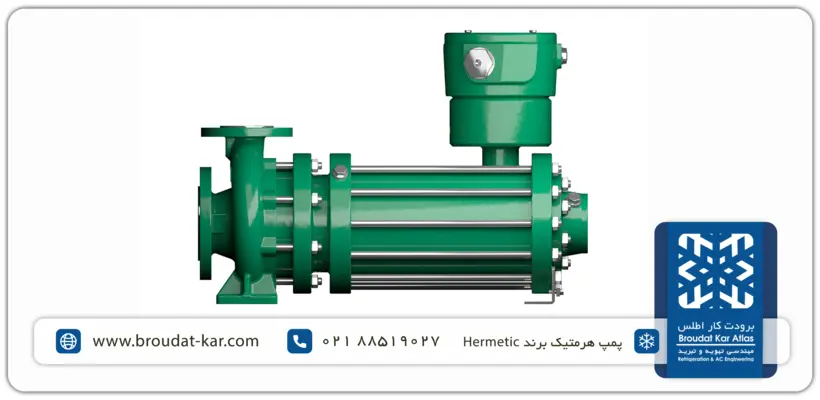
1. Canned Motor Pump (Hermetic Ammonia Pump)
Canned motor pumps are widely used for ammonia refrigeration because the pump hydraulics and motor stator are contained within an integrated, hermetically sealed metal housing.
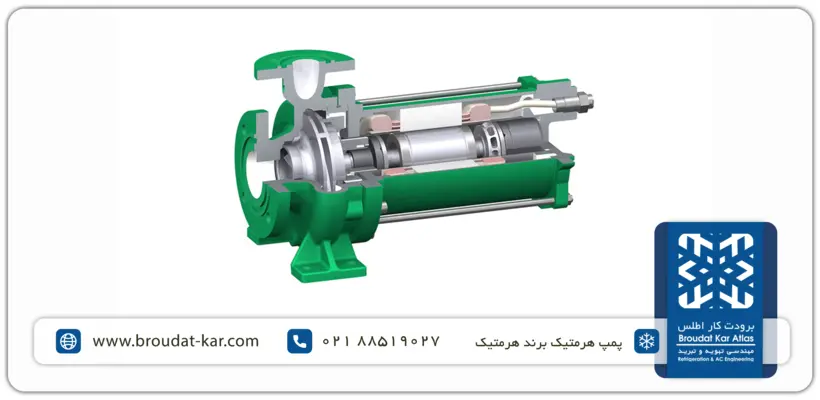
- Construction: No external mechanical seal, coupling or externally lubricated bearing arrangement is required. The ammonia refrigerant provides cooling for the motor and lubrication for internal graphite bearings.
- Very low external-leak risk: There is no rotating shaft extending through the housing.
- Low maintenance: Eliminating wear components such as an external mechanical seal can reduce routine maintenance requirements.
- Low-temperature capability: The source specifies operation at temperatures down to approximately −50°C for suitable models.
- Examples mentioned in the source include HERMETIC Pumpen CAM and CNF series and TH. Witt HRP series.
2. Mechanical-Seal Ammonia Pump
Mechanical-seal pumps use a more traditional arrangement in which a standard electric motor is coupled to the pump shaft. A mechanical seal is used to prevent refrigerant from escaping around the rotating shaft.
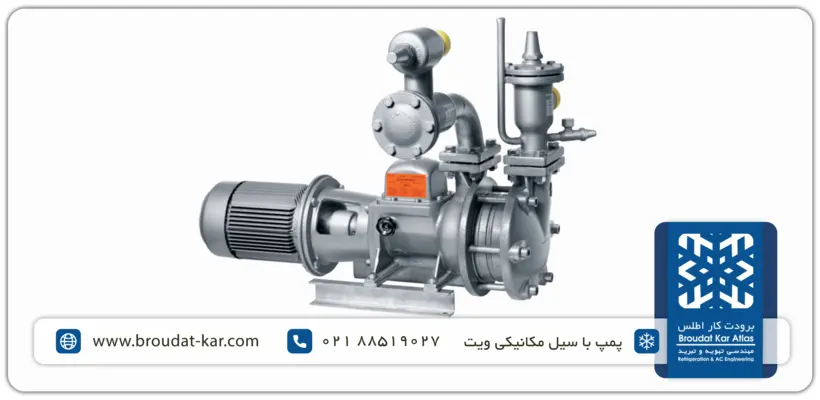
- Construction: The shaft exits the pump housing and requires mechanical sealing, often using a double mechanical seal or an intermediate liquid arrangement for leakage control.
- Ammonia-leak risk: Because ammonia is toxic and highly penetrating, mechanical-seal wear or failure can result in refrigerant release into the machinery room.
- Ongoing maintenance: Mechanical seals are wear components and require periodic inspection and replacement.
- Current application: The source describes these pumps as more common in older projects and states that hermetic designs may be preferred during modernization and overhaul work.
Hermetic vs. Mechanical-Seal Ammonia Pumps
| Mechanical-Seal Pump | Hermetic / Canned Motor Pump | Comparison Factor |
| Medium to low; seal failure can create a leakage risk | Very high; sealed construction minimizes external leakage | Safety level |
| Regular inspection and seal replacement | Minimal routine maintenance requirement | Maintenance |
| Medium | Very high | Reliability |
| Lower | Higher | Initial capital cost |
| Greater limitations at very low temperatures | Suitable models can operate down to about −50°C | Operating temperature |
| Older systems / less demanding transfer applications | Modern ammonia refrigeration projects | Typical application |
| Cornell CB, TH. Witt | HERMETIC, Cornell HT, TH. Witt | Brands mentioned in source |
Ammonia Refrigeration Pump Selection Parameters
Selecting an ammonia refrigeration pump requires careful thermodynamic and hydraulic calculations. An error in pump head or NPSH calculations can cause refrigerant flashing, cavitation and rapid impeller damage. The following parameters should be evaluated by the system designer.
1. Calculate the Required Refrigerant Flow Rate
Pump flow is directly related to the refrigeration capacity and the selected overfeed ratio. First determine the refrigerant mass flow required to meet the cooling load, then apply the overfeed factor.
- Example: For a system with a 500 kW cooling load and a 1:4 overfeed ratio, the pump must circulate four times the amount of refrigerant that evaporates in the evaporator.
2. Calculate Total Dynamic Head
Ammonia pump head is commonly expressed as metres of liquid column and consists of several components:
- Static elevation: The vertical distance between the liquid level in the ammonia separator and the highest point of the evaporator.
- Piping pressure drop: Friction losses through pipes, elbows, valves and filters.
- Evaporator and nozzle pressure drop: Internal evaporator pressure losses and losses across control devices.
- The source gives a typical working-head range of approximately 15–45 m of liquid column.
3. Check NPSH and Prevent Cavitation
Cavitation is a major hydraulic failure mode in ammonia refrigerant pumps. Because ammonia in the separator may be near its boiling point and in a saturated condition, even a small pressure drop in the suction line can cause the liquid to flash and form vapor bubbles.
- The available net positive suction head (NPSHa) should remain greater than the pump’s required NPSH (NPSHr). The source recommends positioning the ammonia separator above the pump inlet, typically by about 1.5–3 m, to support adequate suction conditions.
4. Verify the Operating Temperature Range
R717 ammonia can operate at very low evaporating temperatures. The selected hermetic or mechanical pump must be rated for the actual design temperature; the source specifies suitable construction for temperatures down to approximately −50°C.
5. Check Material Compatibility with Ammonia
The source states that ammonia is strongly corrosive to materials such as copper, brass and zinc. It recommends compatible materials such as stainless steel or ductile iron for pump components, subject to the actual equipment manufacturer’s specifications and the applicable engineering standard.
Reference Standards and Pump-Selection Tools
The source recommends that system calculations and equipment layout follow the applicable IIAR guidance and mentions IIAR Bulletin 107 as a reference. It also points to manufacturer selection tools, including HERMETIC Pumpen’s design tools, as aids to pump selection.
Oil Separator: An Important Part of an Ammonia Pumping System
Mineral compressor oil is not miscible with liquid ammonia. Oil leaving the compressor can therefore travel through the refrigeration circuit as droplets or suspended particles. This makes oil separation important for protecting the pump and preserving evaporator heat transfer.
- Separation mechanism: As the oil-containing flow enters the separator and velocity decreases, the higher-density oil settles and collects in the lower oil-separator section.
- Pump and heat-transfer protection: If oil enters the pump suction and reaches the evaporator, it can form a film on internal surfaces and reduce heat transfer. The pump should therefore draw clean liquid refrigerant from the appropriate part of the separator.
- Oil-drain indication: The source describes frost on the oil-separator vessel as a normal operating indication and states that loss of frost on part of the vessel may indicate that oil has displaced a significant volume of refrigerant. Oil removal must follow the system’s safety procedure.
Ammonia Refrigeration Pump Troubleshooting
Continuous monitoring of pump operating conditions is important for preventing refrigeration-system downtime and costly damage. The table below translates the source troubleshooting matrix into standard English technical terminology.
| Recommended Action | Possible Cause | Observed Symptom |
| Check the electrical panel, test the contactor and measure incoming current. | Power interruption, contactor trip or power-circuit fuse fault | Pump will not start |
| Check separator liquid level, vent the line as required and verify the discharge path. | Cavitation or stuck check valve | Pump runs but has no flow |
| Measure pump inlet pressure and reassess suction/NPSH conditions. | Cavitation or impeller imbalance / damage | Abnormal vibration and noise |
| Check the bypass path and minimum-flow circulation. | Operation below the minimum permitted flow | Pump body temperature is high (hermetic) |
| Stop the pump, isolate the circuit and clean the strainer. | Blocked inlet filter / strainer | Severe drop in pump differential pressure |
| Repair or replace the mechanical seal, isolate the circuit and ventilate the machinery room. | Mechanical-seal wear or damage on open-type pumps | Refrigerant leakage from the pump |
| Adjust service valves and verify pump flow and head. | Incorrect overfeed ratio or insufficient pump flow | Cold room does not reach the target temperature |
| Vent trapped sections and remove trapped gases before start-up according to the system procedure. | Liquid trapping | Piping shock after start-up |
How to Distinguish Cavitation from Electromechanical Pump Faults
A common troubleshooting mistake is confusing cavitation noise with bearing wear or motor-related faults.
- Cavitation: Often sounds like gravel or sand moving inside the pump casing and may be accompanied by strong fluctuations in discharge differential pressure. Possible causes include inadequate refrigerant supply, low separator liquid level or excessive inlet-fluid temperature.
- Electromechanical motor fault: More likely to produce a steady, low-frequency abnormal sound together with mechanical vibration, unusually high current draw or repeated thermal trips.
Ammonia Refrigeration Pump Safety
R717 ammonia is widely used in industrial refrigeration because of its thermodynamic performance, but its toxicity and other hazards mean that ammonia pump operation and maintenance require formal safety procedures. A leak on the pump suction or discharge side can expose machinery-room personnel to hazardous refrigerant.
Current industry guidance emphasizes engineered safety systems, operating procedures, competent personnel, emergency planning and appropriate personal protective equipment. IIAR guidance specifically includes refrigerant pumps within ammonia-system safety criteria, while the Institute of Refrigeration’s ammonia safety code addresses liquid ammonia pumps, material selection, system design, installation and maintenance.
Preventive Safety Procedures
- Lockout/Tagout (LOTO): Before servicing the pump, opening a strainer or performing repairs, isolate and lock out the electrical supply according to the facility’s procedure.
- Pressure isolation and venting: Isolate pump inlet and outlet lines and manage residual ammonia pressure using the site’s approved recovery, neutralization or venting procedure.
- Personal protective equipment: Personnel servicing ammonia equipment should use the PPE specified by the facility risk assessment and applicable safety standard, including suitable eye/face, hand, body and respiratory protection where required.
- Leak detection: Ammonia detection and alarm systems should be installed and maintained in accordance with the applicable design and safety requirements.
- Material restrictions: The source advises against copper, brass, zinc and their alloys in ammonia-system connections and components. Final material selection must follow the equipment manufacturer and applicable code requirements.
IIAR safety publications cover refrigerant pumps, machinery-room safety, inspection and operating practices. The Institute of Refrigeration also identifies EN 378 and its ammonia safety code as important references for ammonia refrigeration systems.
Leading Ammonia Pump Brands and Availability Considerations
Brand selection can affect reliability, serviceability and safety. The original content identifies the following manufacturers and pump families:
| Features Mentioned in Source | Series / Model | Country | Manufacturer |
| Canned-motor design and leak-tight construction | CAM, CNF | Germany | HERMETIC Pumpen |
| Long-standing refrigeration applications and high durability | CB Series, HT Series | United States | Cornell Pump |
| High-pressure capability and low-temperature performance | HRP | Germany | TH. Witt |
| Double mechanical-seal design for specific applications | 4924A | United States | Viking Pump |
Why Choose Brudat Kar Atlas for Ammonia Pump Selection?
Designing and building a large industrial ammonia refrigeration system is more than purchasing individual components. Selecting an ammonia pump without considering separator capacity, piping pressure drop, evaporator characteristics and electrical and protection requirements can create operational and safety challenges.
Brudat Kar Atlas positions ammonia refrigeration pump selection as part of the engineering of the complete refrigeration circuit. The source states that its technical team evaluates thermodynamic parameters and coordinates pump selection with the electrical panel, protection systems and applicable international standards.
For technical consultation, refrigeration-load calculation and pump selection, contact the technical team: +9821-88303600.