



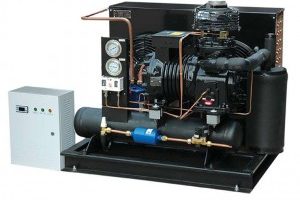
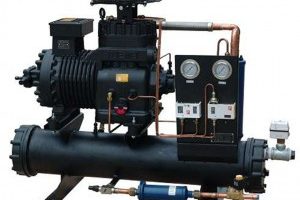
Condensing unit

Condensing Unit

A condensing unit is the high-pressure side package (High-Pressure Side) of a vapour-compression refrigeration cycle: it receives low-pressure refrigerant vapour from the evaporator’s suction line, compresses and condenses it back into liquid refrigerant, and returns it to the expansion circuit. This integrated system is the decisive factor in the efficiency, stability, and service life of any industrial cold room or HVAC equipment.
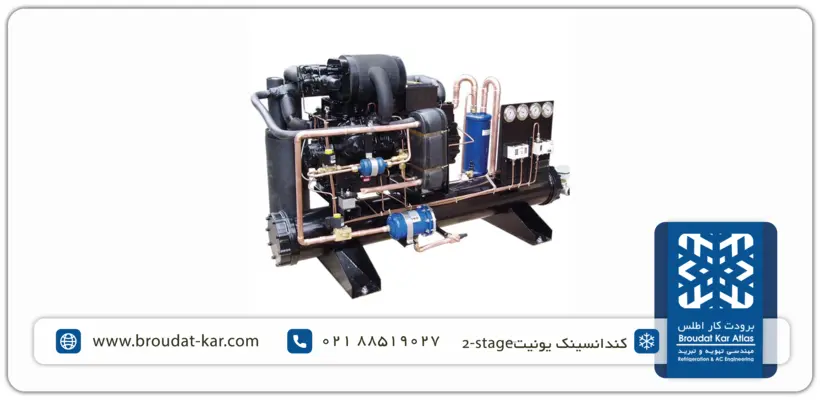
 Two-stage condensing unit with a two-stage compressor for industrial refrigeration systems

Condenser vs. Condensing Unit — What Is the Difference?

One of the most common procurement errors is treating a condenser and a condensing unit as the same component. A condenser is simply a heat exchanger — its sole function is to reject heat from the refrigerant and convert it to liquid. A condensing unit, by contrast, is a complete refrigeration package.

The unit receives low-pressure vapour from the suction line (evaporator outlet) and, in addition to the condenser coil and fans, houses all critical components — compressor, liquid receiver, filter drier, dual pressure switches (high/low), oil separator, and liquid line valves — pre-assembled on a single heavy-duty chassis, so that condensed liquid refrigerant is returned directly to the expansion circuit at the evaporator inlet. Consolidating all types of condensing unit onto one industrial chassis minimises field pipework, reduces refrigerant leak risk, and significantly accelerates and simplifies installation.

Types of Condensing Unit — Heat Rejection Mechanism

The design of types of condensing unit is classified by the mechanism used to reject heat from the condensed refrigerant. The choice between the two types depends directly on site climate, water availability, and project cooling capacity:

Air-Cooled Condensing Unit

In this configuration, heat is rejected from the refrigerant via ambient airflow through axial fans and finned condenser coils. The air-cooled condensing unit requires no secondary water circuit and is the preferred choice for most climates and mid-range capacities, owing to simpler maintenance and lower infrastructure cost.
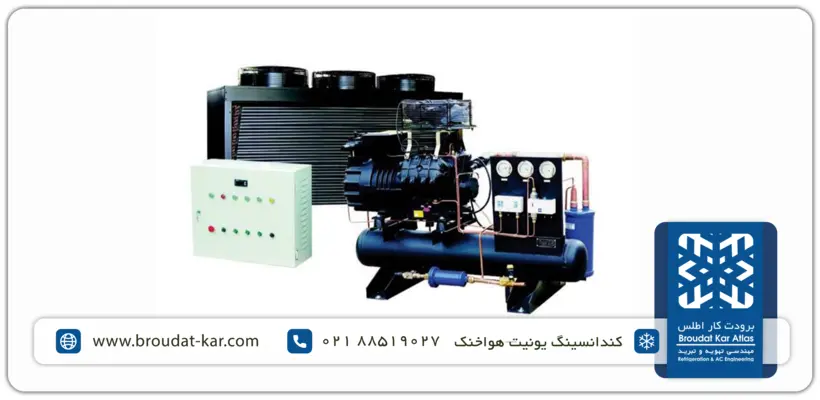
 Industrial air-cooled condensing unit with compressor, condenser, and electrical control panel

Water-Cooled Condensing Unit

In this design, a shell-and-tube or plate heat exchanger handles heat rejection from the refrigerant. The water-cooled condensing unit delivers higher COP and lower condensing temperatures, making it ideal for large-capacity projects or installations where outdoor placement of an air-cooled condenser is not feasible — provided a cooling tower and water circuit are available.
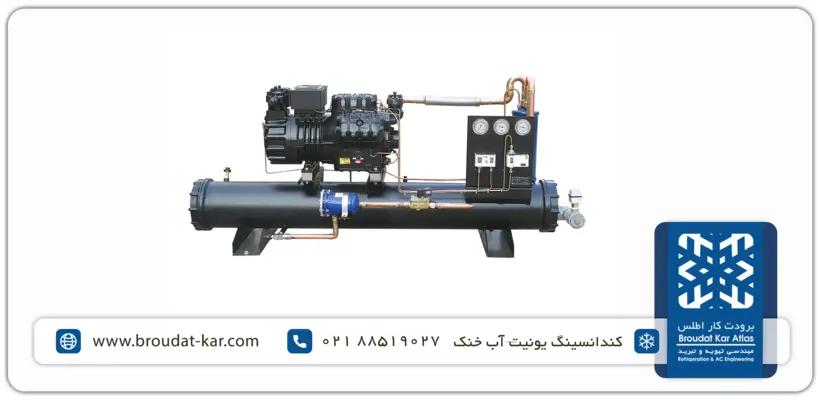
 Industrial water-cooled condensing unit equipped with a reciprocating compressor and control panel

Air-Cooled vs. Water-Cooled Condensing Unit — Comparison Table

Air-Cooled Water-Cooled Selection Criterion
None — no secondary circuit needed Cooling tower + water pipework required Ancillary equipment required
Lower (limited by air heat capacity) Higher (superior heat transfer coefficient; lower condensing temp) Heat transfer efficiency
Lower — optimised for small-to-medium capacity Higher — cooling tower and installation add to CAPEX Initial investment
Governed by ambient dry-bulb temperature Governed by wet-bulb temperature; efficiency drops in very humid climates Climate limitation
Simple — periodic fin cleaning Requires water treatment, descaling, and cooling tower maintenance Maintenance
.wpdt-c.wpDataTableContainerSimpleTable { direction: rtl; }.wpdt-bc-E9E9E9 { background-color: #E9E9E9 !important;} .wpdt-fs-000013 { font-size: 13px !important;} .wpdt-ff-000000 { font-family: inherit !important;}

Applications of Industrial Condensing Units

The integrated design and high reliability of the industrial condensing unit have made these packages the core refrigeration driver across a wide range of industrial and commercial projects. The most important application areas are:

  • Industrial Cold Rooms: Supplying cooling capacity for above-zero circuits (fruit and pharmaceutical storage), sub-zero circuits (meat and frozen goods), and blast freezing tunnels — using semi-hermetic reciprocating, screw, or open-type compressors.
  • HVAC, Clean Rooms, and Pharmaceutical / Hospital Facilities: Industrial air handling units, pharmaceutical cooling packages, and hospital HVAC systems rely on the outdoor condensing unit to deliver precise temperature and humidity control.
  • Food Processing and Dairy: Cooling for processing halls, packing lines, pre-cooling tunnels, and dairy storage tanks for milk and dairy products.

Key Parameters for Condensing Unit Selection

Selecting the right condensing unit requires full alignment between package specifications and actual site conditions. The following parameters must be evaluated before purchase to avoid capacity losses and wasted capital:

  • Accurate Cooling Load Calculation: Determining real-world capacity based on room dimensions, insulation quality, product load, and heat infiltration.
  • Operating Temperature Range: Defining the evaporator design temperature (above-zero or sub-zero) to select a compressor matched to the correct suction pressure.
  • Site Climate Conditions: Factoring in maximum summer ambient temperature to correctly size the air-cooled condenser coil and prevent unit overload.
  • Component Brand and Authenticity: Evaluating compressor brand (Bitzer, Copeland, Danfoss) and liquid line valves (Danfoss, Castel) — both directly impact system longevity and warranty validity.
  • Complete Package Verification: Confirming that critical components — liquid receiver, filter drier, solenoid valve, sight glass, oil separator, and safety controls — are included in the base quoted price.

Factors Affecting Condensing Unit Price

Accurate condensing unit pricing is only possible after cooling load calculation and full component specification. The primary cost drivers are:
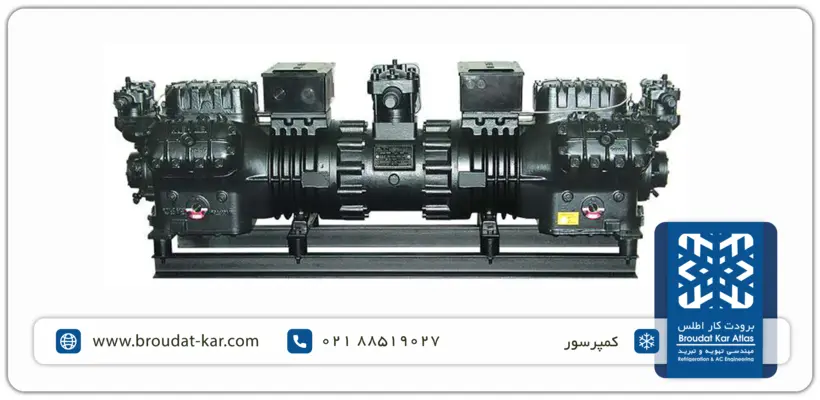
  • Compressor Type and Capacity: Compressor architecture (scroll, reciprocating, or screw) and brand carry the largest share of base cost.
  • Condenser Coil Dimensions and Material: Fin density, heat rejection capacity, and axial fan brand in air-cooled configurations.

 Multi-cylinder reciprocating compressor for industrial refrigeration systems

  • Liquid Line and Control Equipment: Inclusion of oil separator, accumulator, sight glass, and solenoid valve.
  • Control Panel Automation Level: Quality of electrical components, pressure switches, and microprocessor controller specification.

Buyer Checklist — Before Placing a Condensing Unit Order
  • Essential package components: Are all base components — compressor, condenser coil, fan(s), liquid receiver, filter drier, dual pressure switches, and control panel — pre-mounted on the chassis?
  • Liquid line item clarification: Are the liquid receiver and filter drier included in the total package price, or quoted separately?
  • Climate compatibility check: Has the condenser capacity been sized against the maximum critical summer ambient temperature (Max Ambient Temp) at your project site?

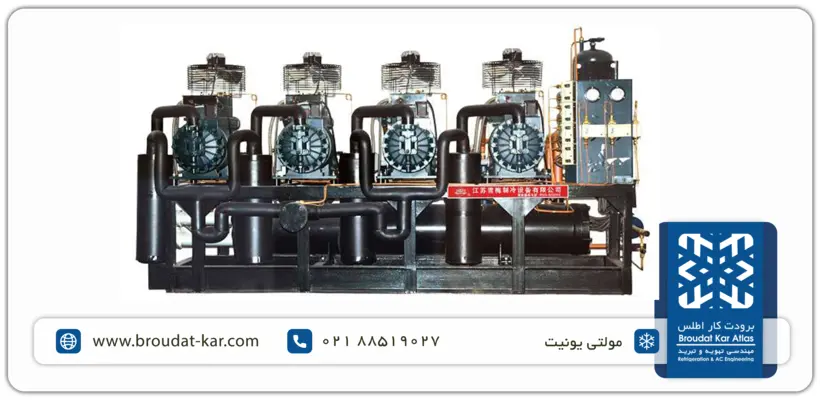
 Industrial refrigeration multi-unit system with multiple compressors and control equipment

Condensing Unit Design and Manufacturing at Atlas Refrigeration Co.

Atlas Refrigeration Co. designs and manufactures condensing units to the highest engineering standards, backed by decades of large-scale industrial project experience. Every package is sized from first principles. Key advantages of ordering from Atlas:

  • Engineering-first sizing: Custom component sizing based on site climate, evaporator temperature, and refrigerant type.
  • Heavy-duty chassis fabrication: Standard steel sections with electrostatic powder coating and anti-vibration mounts to reduce noise and structural stress.
  • Certified genuine components: Compressors and valves sourced from Bitzer, Copeland, Danfoss, and Castel — with full authenticity certification.
  • Pressure testing before dispatch: Full pressure and leak-detection testing on every package prior to delivery.
  • Warranty and specialist after-sales support: Installation, commissioning, and spare parts supply backed by valid warranty.

Frequently Asked Questions — Condensing Unit

1- What is the main difference between a condenser and a condensing unit?

A condenser is only a heat exchanger for rejecting refrigerant heat. A condensing unit is a complete package — comprising the compressor, condenser, fans, liquid line equipment (receiver, filter drier), pressure switches, and control panel, all pre-assembled on a single chassis.

2- For an industrial cold room, which is better — air-cooled or water-cooled?

If you have a reliable water supply and the site climate is not excessively humid, a water-cooled system delivers higher efficiency. Otherwise, the air-cooled unit is the preferred option due to its lower infrastructure requirement and simpler maintenance.

3- How is condensing unit capacity determined?

Capacity is calculated based on the total project cooling load, evaporator temperature range (above-zero or sub-zero), refrigerant type, and the maximum ambient temperature at the installation site during peak summer conditions.

Air-Cooled Condensing Unit An air-cooled condensing unit is a compact system that includes a compressor, condenser, fan, and expansion valve.

Water-Cooled Condensing Unit A water-cooled condensing unit is a crucial component in refrigeration and HVAC (Heating, Ventilation, and Air Conditioning)