

Cold Room Expansion Valve: A Complete Guide from Selection to Troubleshooting
A cold room expansion valve – also called an expansion valve or metering device – is one of the four essential components of the vapour-compression refrigeration cycle, fitted between the condenser’s liquid line and the evaporator inlet. Its job looks simple: create a sudden pressure drop in the liquid refrigerant and control exactly how much refrigerant enters the evaporator. But if the valve is poorly selected, installed or adjusted, the thermal balance of the whole system is upset, with consequences ranging from a sharp loss of cooling capacity to complete compressor failure. This guide gives technicians, engineers and cold room owners the technical detail they need: valve types, sizing, the superheat formula and a full fault-finding table.
What Is a Cold Room Expansion Valve and How Does It Work?
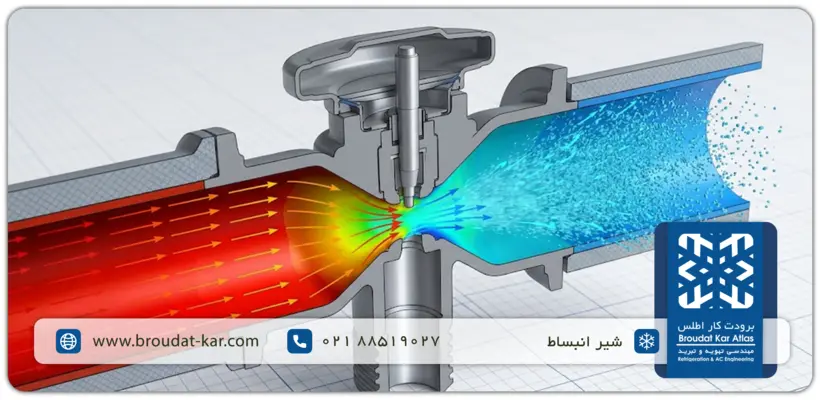
In a standard vapour-compression cycle, the refrigerant leaves the condenser as a warm, high-pressure liquid and reaches the expansion valve. The valve forms a narrow restriction that drops the refrigerant pressure suddenly, turning it into a cold, low-pressure mixture of liquid and vapour that is ready to absorb heat from the cold room in the evaporator.
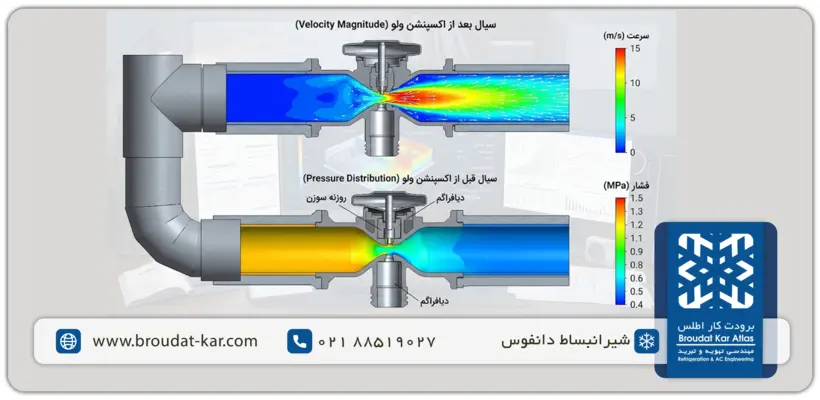
A thermostatic expansion valve (TXV) works by balancing three main forces:
- Opening force – bulb pressure (P_bulb): the pressure of the fluid inside the thermal bulb, acting on top of the diaphragm. It depends directly on the temperature of the suction line leaving the evaporator.
- First closing force – evaporator pressure (P_evap): the evaporator outlet pressure acting under the diaphragm, in the closing direction.
- Second closing force – spring pressure (P_spring): the mechanical force of the adjustment spring, which is under preload and limits how far the needle can open.
When the cold room temperature rises, the suction line temperature – and so the thermal bulb temperature – rises with it. The bulb pressure increases and pushes the diaphragm down, the needle opens further, and more refrigerant enters the evaporator to meet the new cooling load. When the temperature falls, the bulb pressure drops, and the spring force together with the evaporator pressure moves the needle towards closing. This continuous process keeps the superheat of the gas leaving the evaporator within a safe, efficient range.
Types of Cold Room Expansion Valve
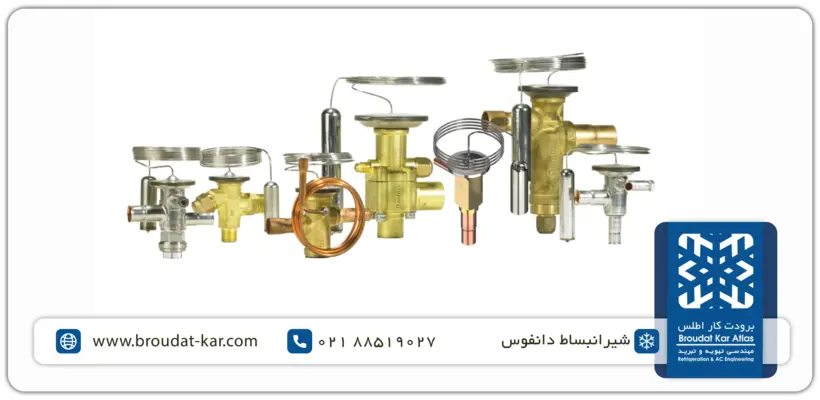
Expansion valves fall into three main groups according to mechanical design, control accuracy and how refrigerant flow is regulated: the thermostatic expansion valve (TXV), the electronic expansion valve (EEV) and the capillary tube. Choosing correctly has a direct effect on cold room efficiency and on the stability of the refrigeration cycle.
Thermostatic Expansion Valve (TXV) for Cold Rooms
The thermostatic expansion valve (TXV) is the most common type of expansion valve in refrigeration. It is fully mechanical and regulates refrigerant flow without electrical power or an electronic controller.
Main components of a thermostatic expansion valve:
- Valve body and needle: control the refrigerant flow rate.
- Metal diaphragm: the pressure-sensitive plate that moves the needle.
- Thermal bulb and capillary tube: the temperature sensor attached to the suction line.
- Superheat adjustment spring: sets the preload and the valve’s balance point.
- External equalizer port (optional): compensates for pressure drop through the evaporator.
Key point: on evaporators where the refrigerant pressure drop exceeds 0.5 bar, an expansion valve with an external equalizer is mandatory. Otherwise the real evaporator outlet pressure differs from the pressure under the diaphragm and the valve will malfunction badly.
In the market, Danfoss TE2 and TE5, Danfoss TE12, Alco and Castel expansion valves hold the main share in both sub-zero and above-zero cold rooms.
Electronic Expansion Valve (EEV) for Cold Rooms
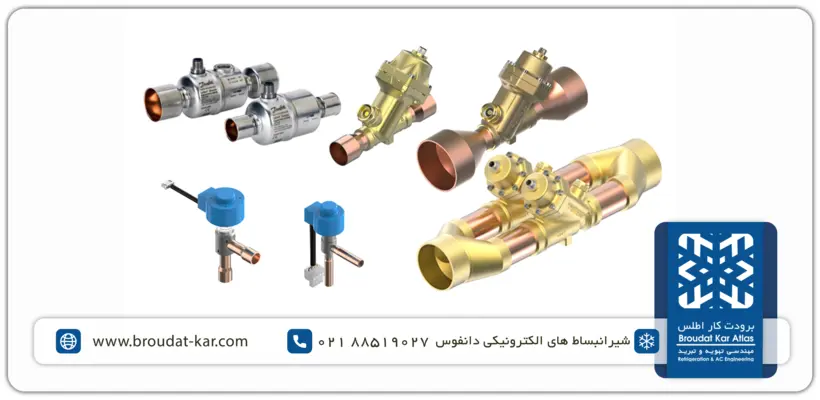
The electronic expansion valve (EEV) is the newer, smarter generation of expansion valve. Instead of pressure-based mechanics, it uses a high-precision stepper motor to control needle opening. To work properly it needs commands from a central controller and data from a suction pressure sensor and an evaporator outlet temperature sensor – typically integrated into the cold storage electrical panel.
Main advantages of an EEV
- Exceptional accuracy: superheat control of ±0.5 °C, compared with ±3 to 5 °C for thermostatic models.
- Fast response to load changes: ideal for cold rooms with strongly varying cooling loads.
- Lower energy use: makes full use of the evaporator’s heat-transfer surface and reduces compressor running time.
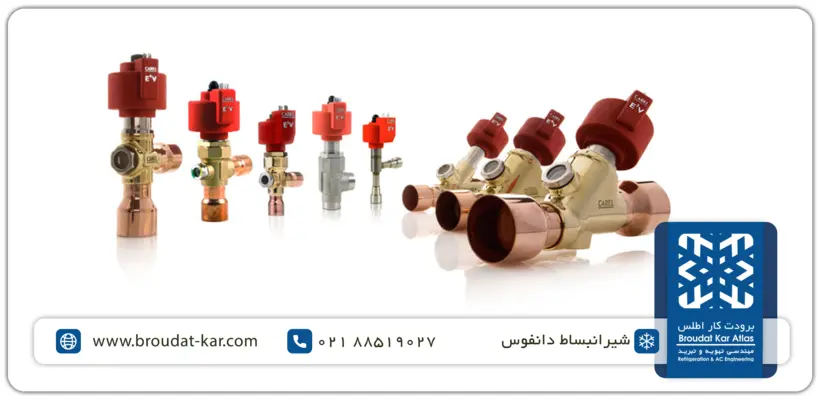
Well-known EEV models include the Danfoss ETS series (including ETS Colibri), Carel E2V, Sporlan SEI and Sanhua electronic valves.
Capillary Tube
The capillary tube is the simplest metering device in a refrigeration cycle. It has no moving parts and reduces the liquid refrigerant pressure purely through friction and its small internal diameter.
However, it suits only very small refrigeration systems with a constant load, such as domestic refrigerators or shop freezers. It is never used in industrial or commercial cold rooms, because it cannot adapt to changes in cooling load.
TXV vs EEV: Comparison Table
| Thermostatic expansion valve (TXV) | Thermostatic expansion valve (TXV) | Criterion |
| Mechanical, self-acting (bulb pressure) | Mechanical, self-acting (bulb pressure) | Control type |
| ±3 to 5 °C | ±3 to 5 °C | Superheat accuracy |
| No (fully independent) | No (fully independent) | Controller and power needed |
| Economical, low | Economical, low | Initial purchase and installation cost |
| Small and medium cold rooms with a steady load | Small and medium cold rooms with a steady load | Best application |
| Danfoss TE5/TE12, Alco, Castel | Danfoss TE5/TE12, Alco, Castel | Leading brands |
How to Choose a Cold Room Expansion Valve
Choosing the right cold room expansion valve means checking the thermodynamic parameters of the refrigeration system carefully. An undersized valve starves the evaporator, so the room never reaches temperature. An oversized valve causes strong pressure swings and lets liquid refrigerant flood back to the compressor.
Check these five parameters before choosing an expansion valve:
- Refrigerant type: every thermostatic or electronic expansion valve is designed for specific refrigerants such as R404A, R507, R134a or R22. For example, the thermal bulb of a Danfoss TEX5 carries a specific refrigerant charge so that the diaphragm pressure matches that refrigerant’s characteristics.
- Nominal cooling capacity: the valve capacity, measured in kilowatts (kW) or tons of refrigeration (TR), must match the evaporator load exactly. Before buying, calculate it accurately with a cold room load calculation.
- Evaporating temperature: the evaporator design temperature (for example −25 °C for a sub-zero meat store, or −5 °C for an above-zero fruit store) sets the working range of the valve needle.
- Operating pressure difference: refrigerant enters the valve at condenser (high) pressure and leaves at evaporator (low) pressure. This difference determines the flow rate. Where evaporator pressure drop is high, use a valve with an external equalizer.
- Target superheat range: cold room superheat is normally set between 5 °C and 8 °C (about 9–14 °F) to get maximum thermal efficiency without risking liquid reaching the compressor.
Software Tools for Expansion Valve Selection
To avoid human error in hand calculations, engineers and refrigeration designers use the official software of the manufacturers:
- Danfoss Coolselector: the most comprehensive free Danfoss calculation tool, for selecting Danfoss TE5, TEX12 and Danfoss ETS electronic valves accurately.
- Alco Selection Software: for calculating and selecting Alco expansion valves for different operating conditions.
How to Install and Set a Cold Room Expansion Valve
Correct installation and adjustment is key to getting the best from the refrigeration system. The smallest mistake in fitting the thermal bulb or the equalizer line can cause a false temperature reading and complete loss of refrigerant control.
Critical Installation Points
- Flow direction: the arrow on the valve body must point in the direction of refrigerant flow from the condenser to the evaporator.
- Thermal bulb position: fit the bulb on a horizontal section of the suction line (evaporator outlet), upstream of the equalizer tap. Clamp it at the 1 or 4 o’clock position around the pipe, never at the bottom where oil collects. The metal clamp must be tight, and the bulb and pipe must be covered with suitable thermal insulation.
- External equalizer connection: connect the equalizer line to the top of the suction line, about 10 to 15 cm downstream of the thermal bulb, so that liquid refrigerant or oil cannot enter the equalizer line.
- Full system evacuation: always evacuate the circuit before charging and starting up. Moisture will freeze in the tiny orifice of the valve.
Step-by-Step Superheat Setting for a Cold Room
Setting the superheat makes sure the liquid fully evaporates in the evaporator and stops liquid returning to the compressor.
Superheat = T_actual − T_saturation
- Step 1 – measure suction pressure: connect a gauge to the compressor suction port or the evaporator outlet and read the suction pressure. Using the refrigerant’s pressure–temperature chart, find the saturation temperature (T_saturation).
- Step 2 – measure actual suction temperature: place a calibrated thermometer or contact sensor on the suction line exactly where the thermal bulb sits, and record the real gas temperature (T_actual).
- Step 3 – calculate the superheat: subtract the saturation temperature from the actual suction line temperature. The result is the system’s current superheat. The standard range is 5 to 8 °C.
- Step 4 – turn the valve adjustment screw:
- If superheat is high (> 10 °C): the evaporator is short of refrigerant. Turn the adjustment screw anticlockwise to reduce the spring force so the valve opens more.
- If superheat is low (< 3 °C): too much refrigerant is entering the evaporator. Turn the adjustment screw clockwise to increase the spring force so the valve closes more.
Never rush: after each turn of the adjustment screw (at most half to one turn per step), wait 15 to 20 minutes for the system to stabilise and for the new superheat to settle on the gauges and thermometer.
Signs of a Faulty Cold Room Expansion Valve and Troubleshooting
Spotting a malfunctioning cold room expansion valve early prevents serious compressor damage and spoilt stock. Most expansion valve problems come from incorrect superheat settings, contamination or moisture in the cycle, or mechanical damage to the diaphragm and needle.
Expansion Valve Troubleshooting Table
| Diagnosis and corrective action | Probable cause 2 | Probable cause 1 | Symptom |
| Check the temperature difference across the filter drier and inspect the valve needle | Blocked filter drier or valve needle | Valve stuck closed | Low suction pressure + high superheat |
| Measure subcooling and check how far the needle opens | Refrigerant overcharge | Valve stuck open | High suction pressure + low superheat |
| Replace the filter drier and use a standard moisture remover | Partial blockage in the valve inlet strainer | Moisture and a frozen orifice | Frost on the valve body |
| Tighten the superheat screw (clockwise) and check bulb position | Superheat set to zero or negative | Liquid flood-back | Frosted suction line back to the compressor |
| Compare valve capacity with the calculated evaporator load | Partial restriction in the liquid line | Valve capacity too small for the load | Cold room does not reach target temperature |
| Tighten the bulb connection and readjust the spring | Loose or uninsulated thermal bulb clamp | Superheat incorrectly set | Constant temperature swings (hunting) |
| Shut the system down immediately to prevent damage to connecting rods and valves | Refrigerant not evaporating in the evaporator | Liquid returning to the compressor (liquid slugging) | Knocking or uneasy running noise in the pipes |
The Two Main Failure Modes of an Expansion Valve
- Valve stuck closed (starved evaporator)
Not enough refrigerant reaches the evaporator. The main signs are:
- A sharp drop in suction pressure and very high superheat (above 15 °C).
- Frost only at the evaporator inlet, while the rest of the cold room stays warm.
- An excessively hot compressor body, because the suction gas is not cooling it properly.
- Valve stuck open (flooded evaporator)
Liquid refrigerant passes through the evaporator without fully evaporating and enters the suction line. The main signs are:
- Low superheat (below 3 °C) or zero.
- Icicles and heavy frost on the suction line all the way to the compressor inlet.
- A high risk of liquid slugging, which can break compressor valves and bend connecting rods within seconds. If you see this, shut the system down immediately and fix the problem. For more on the consequences, see our compressor pages and compressor spare parts.
How to Tell a Faulty Expansion Valve from a Low Refrigerant Charge
One of the most common diagnostic mistakes in cold room servicing is confusing a faulty thermostatic expansion valve with a lack of refrigerant, because both cause low suction pressure:
- Low refrigerant charge: subcooling in the liquid line drops sharply or falls to zero.
- Blocked or faulty expansion valve: subcooling in the liquid line is normal or even higher than standard, because refrigerant is backing up behind the valve.
Conclusion: measuring superheat and subcooling together is the only reliable way to separate an expansion valve fault from a low refrigerant charge.
Expansion Valve Maintenance and Service Life
A cold room expansion valve is a durable component. With sound engineering and correct installation, the service life of European thermostatic valves such as Danfoss is typically 10 to 15 years. Neglecting periodic servicing of the refrigeration cycle, however, can damage this critical part.
- Control moisture in the cycle: moisture in the refrigerant is the expansion valve’s main enemy. At low pressure and low temperature it freezes in the needle orifice, blocking the passage or jamming the needle. Replacing the filter drier on time directly protects the valve.
- Inspect the thermal bulb periodically: dirt build-up or a loose bulb clamp on the suction line disturbs heat transfer and sends wrong signals to the diaphragm. The bulb must stay tight, free of corrosion and covered with sound thermal insulation.
- Clean the inlet strainer: most standard expansion valves have a fine mesh strainer at the inlet to keep burrs, copper swarf and pipe scale away from the needle. During major services, inspect and wash this strainer.
Cold Room Expansion Valve Buying Guide and Brands
When you buy a cold room expansion valve, do not rely only on pipe size or the nominal power of the compressor. Before requesting a quotation or placing an order, have these technical details ready:
- Refrigerant used (R404A, R507, R134a, R22 or R448A)
- Exact evaporator cooling capacity (in kW or BTU/h)
- Evaporating temperature (sub-zero or above-zero)
- System type (single evaporator, or multiple evaporators with a distribution circuit)
Reputable Expansion Valve Brands
| Features and typical use | Popular series | Country | Brand |
| The market gold standard: excellent build quality, wide availability of spare parts and replacement orifices | TE5, TE12, ETS | Denmark / Poland | Danfoss |
| High mechanical durability; a strong alternative for industrial systems | TX6, TX9, TI | USA / Germany | Alco / Emerson |
| Leader in electronic expansion valves and smart PLC-controlled systems | E2V, E3V (EEV) | Italy | Carel |
| Economical price and suitable quality for small and commercial cold rooms | RFKH, DPF | China | Sanhua |
| Specialist in high-capacity electronic and thermostatic valves | SEI, SER | USA | Sporlan |
Buying warning: unfortunately, counterfeit and copy Danfoss TE5 and TEX12 valves are common on the market. When buying, check the quality of the engraved part code, the serial number, the authenticity hologram and the reliability of the seller.
Engineering and Consultancy Services from Atlas Refrigeration Co.
On every project covering the design, calculation and construction of sub-zero and above-zero cold rooms and freezing tunnels, Atlas Refrigeration Co. treats the choice of cold room expansion valve not as an isolated part but as a sensitive link in the thermodynamic chain of the refrigeration cycle. Our engineers analyse the cooling load, refrigerant type, evaporating temperature and line pressure drops precisely, then select and supply the best-suited model from reputable international brands for your project.
For free expert consultation, price enquiries and supply of genuine parts, contact us and speak to our specialists.
Consultation and sales: +98 21 8830 3600